
At least 13 people have been killed and more than a dozen injured after a massive fire swept through multiple high-rise apartment towers at the Wang Fuk Court housing complex in Hong Kong’s Tai Po district on Wednesday. The blaze, one of the city’s deadliest in years, sent thick smoke and flames across the northern New Territories and left many residents displaced as firefighters worked through the night.
What happened
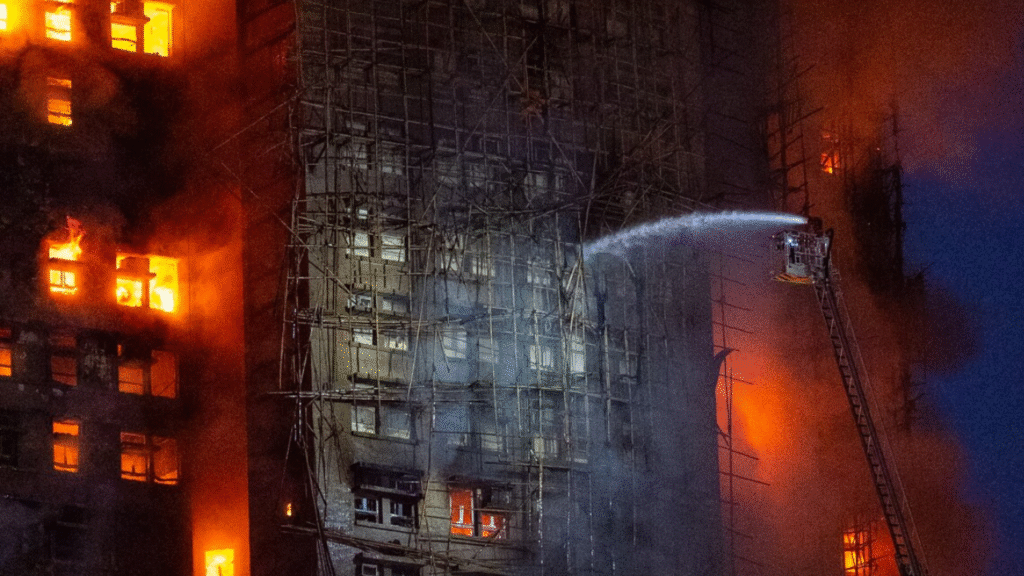
Officials said the fire was first reported mid-afternoon at Wang Fuk Court, a government-subsidized housing estate made up of several 31‑story residential blocks with nearly 2,000 apartments. Fire crews rapidly escalated the alarm level, eventually designating it a No. 5 alarm, the highest category in Hong Kong’s system, as flames spread along bamboo scaffolding and construction netting wrapped around the buildings.
Authorities confirmed that at least 13 people died, including a 37‑year‑old firefighter who lost contact with his crew and was later found with severe burns. Another 15 people were reported injured, with several in critical or serious condition at local hospitals as of Wednesday evening.
Residents trapped and rushed evacuations
Emergency services said they received numerous distress calls from residents trapped in their apartments as smoke and fire climbed the exterior scaffolding and entered flats on multiple floors. Live footage and images from the scene showed flames pouring from windows and balconies, with embers falling to the ground as ladder trucks sprayed water into the burning towers.
Local media reports described chaotic evacuations, with some residents alerted only when security guards or firefighters knocked on their doors to urge them to leave immediately. Elderly residents and families with children were seen being helped away from the complex and directed toward temporary shelters.
Massive emergency response
The Hong Kong Fire Services Department deployed hundreds of personnel and dozens of fire engines and ambulances to the Tai Po estate as the scale of the disaster became clear. Officials said 28 casualties in total were handled by fire services and medical responders, including those who died at the scene and later in hospital.
Hong Kong’s government activated emergency coordination mechanisms to support firefighting operations, hospital surge capacity and relief efforts for displaced residents. Authorities also closed sections of nearby roads and monitored a century‑old railway line that runs close to the complex, as smoke and falling debris raised safety concerns for transport links between Hong Kong and mainland China.
Displaced residents and relief efforts
City officials opened temporary shelters at community centers and a local school to house residents forced from their homes by the fire and lingering smoke. Social workers and volunteers were deployed to provide food, basic supplies and psychological support to families who spent the night away from the damaged towers.
The housing estate, which dates back to the early 1980s and was undergoing major renovation work, is home to thousands of lower‑ and middle‑income residents. Questions quickly emerged about how the blaze was able to spread so rapidly along bamboo scaffolding and construction materials, prompting public concern over fire safety at aging high‑rise estates under repair.
Investigation and next steps
Fire investigators have begun examining the scene, focusing on where the blaze first broke out and how it traveled across multiple blocks of the complex. Early reports point to the role of exterior scaffolding and plastic sheeting in channeling flames up the buildings, but officials have not yet released a formal cause.
Hong Kong’s leader and senior officials expressed condolences to the victims’ families and praised frontline firefighters for their response, while promising a thorough review of safety protocols for construction and renovation at high‑rise residential estates. Authorities said the death toll could still rise as rescue teams continue to search damaged units and hospitals treat critically injured patients.